


Clear Skies is a signatory of the Principles of Responsible Investment (PRI) since 2022. The following is a Case Study conducted by the PRI in 2025 about the Clear Skies Investment Methodology, specifically relating to the in-house tool used to inform decision making, the Clear Skies Impact Radar. The Original article can be found here: https://public.unpri.org/clear-skies-investment-management-using-the-sdgs-to-guide-investment-decisions/12899.article
The Clear Skies Impact Radar is a proprietary tool to assess target company performance on the SDGs and identify weaknesses which could represent risks.
Why we developed an Impact Radar to source equity investments and assess risk in existing holdings
To direct investor capital towards companies and solutions that address the SDGs, we needed a tool that would allow us to compare companies and their business models and assess how they are contributing to the goals. The available service provider tools to measure impact and compare public equity securities fell short in terms of our expectations around accuracy and methodology; they also presented unexplained anomalies. This lack of an effective scoring method meant that we were struggling to identify securities which aligned with our definition of impact investment.
We decided to use raw environmental, social and governance (ESG) data to build our own scoring system and a tool that would allow us to compare different companies’ performance in relation to the SDGs. The result was the internally developed Clear Skies Impact Radar, which we use when looking at potential investments in publicly traded equities. While we do not measure the impact of a company solely based on the SDGs, the Clear Skies Impact Radar provides a solid, measurable and comparable platform for analysis.
How we built the Impact Radar
To develop the Clear Skies Impact Radar, we looked at about 500 ESG factors and mapped them to the 17 SDGs and 169 underlying targets; this mapping process is the foundation of the Impact Radar. The development was conducted as a project with the assistance of 15 analysts and a project manager with an engineering background.
The in-house development methodology
- We used the Business Reporting on the SDGs: An Analysis of the Goals and Targets as a guide which allowed us to make the link between company operations and the SDG targets.
- A confidence level from 1–5 was used to weight the alignment of the ESG factor to an underlying SDG target, with 5 representing the highest level of alignment.
- The raw data are ESG factors that come from databases to which we are subscribed.
- Based on the mapping, an algorithm was built and coded using Python and SQL.
- The algorithm provides a dynamic score for a company relative to its peers in the same sector. There is flexibility in the tool for the selection of peers; this enables the user to select the universe by industry, country, benchmark index or within a range of market capitalisations. The data used for the analysis is cleaned to ensure that only companies with adequate disclosure of ESG data are included.
- The scores, which can be for a specific SDG target or aggregated for a goal, are interpreted as follows.
- A score ranging from 0–100 reflects a company’s percentile ranking for a goal or target when compared to the peers included in the analysis.
- The score for a goal is calculated as the average score of the individual targets of which it is composed.
The Clear Skies Impact Radar and its scoring system allow us to make better informed investment decisions by assessing a company’s relevant contributions to the SDGs compared to its peers.
Clear Skies aggregated the 17 SDGs into five impact investment themes (see Figure 1). A company’s Impact Radar score is calculated as an average of the individual SDGs that compose the investment theme for which it is being considered. The score also permits us to dive deeper into a company’s sustainability performance, identifying potential risks and strengths relating to the SDGs and targets. Over time, we can also monitor the evolution of the Clear Skies Impact Radar scores for specific companies.
Figure 1. Five investment themes – SDGs in each theme
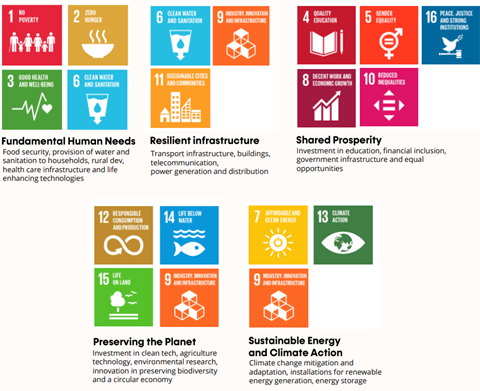
Reproduced with kind permission from Clear Skies Investment Management’s ’Impact Investing Policy’ (page 3).
While the Clear Skies Impact Radar is one of the tools used when conducting company analysis, it is important to note that lower scores on certain goals or targets do not automatically exclude a company from further research. Rather, the scores serve as a starting point for deeper analysis, allowing us to examine the company’s sustainability strategies and operational impacts thoroughly. We are cognizant that smaller companies tend to make fewer disclosures on ESG factors, so the tool can be biased towards larger companies. As investors, we look to engage actively with smaller investee companies and encourage them to improve their ESG disclosure.
The Clear Skies Impact Radar also allows us to identify material sustainability risks. This risk-check identifies low scores and includes key SDG assessments, enabling early action on potential sustainability and material performance issues. After carefully evaluating both the impact strengths along with the sustainability risks, we can determine that a company qualifies for a comprehensive impact analysis.
Application of the Impact Radar for an investment in a company in the waste management sector
Clear Skies was looking at a potential investment in a company operating in the waste management sector. The company, a leader in environmental and industrial services, was being evaluated as a potential investment under the theme of preserving the planet, which relates to SDG 9 (industry, innovation and infrastructure), SDG 12 (responsible consumption and production), SDG 14 (life below water) and SDG 15 (life on land). Nine peers from the waste management sector were selected for the analysis. The market capitalisations of these peers ranged from US$1bn–US$70bn, with the target company in the ~30% percentile ranking. The peer companies were selected using:
- industry-specific tools to identify the closest peers;
- a tailored peer selection process based on companies offering similar products and services.
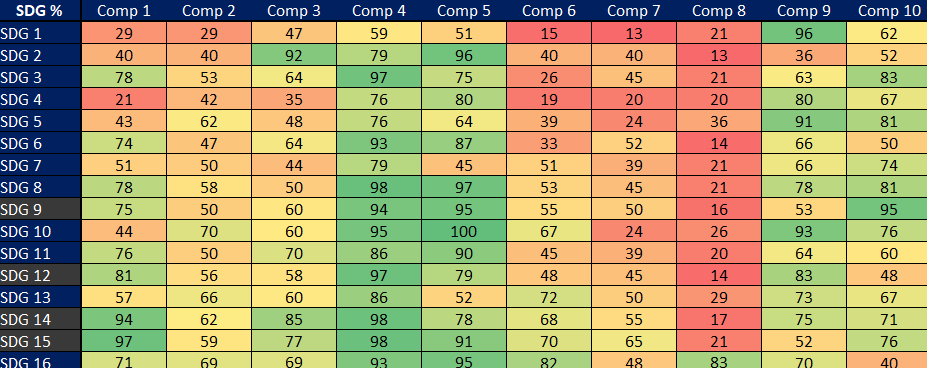
The Clear Skies Impact Radar scores were used as an initial screening tool to evaluate the company’s alignment with the SDGs (see Figure 2). The company performed exceptionally well on SDGs directly aligned with its business model, such as those related to biodiversity conservation and environmental sustainability (SDGs 6, 9, 12, 14 and 15). This demonstrates the company’s robust commitment to mitigating environmental degradation, which is central to its value proposition. Conversely, it scored lower on SDGs that are relatively less material to its core business (for example, SDG 4, quality education).
Figure 2. Impact Radar scores by SDG and for the preserving the planet strategy (SDGs 9, 12, 14, 15)
 In an additional analysis of the SDG target scores for the relevant SDGs (see Figure 3), the company scored above most of its peers. In Figure 4, we highlight the rationale for the inclusion of these SDG targets and the significance to the target company’s operations.
Figure 3. Impact Radar Scores for selected relevant SDG targets
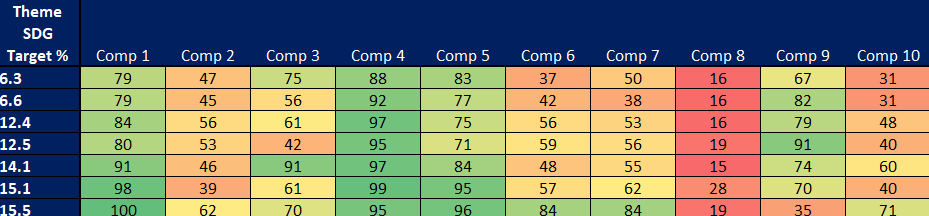
Figure 4. Rationale for inclusion of SDG targets
| SDG 6 | SDG target | Rationale for inclusion |
|---|---|---|
 |
Target 6.3: Improve water quality by reducing pollution, minimizing the release of hazardous chemicals, and increasing wastewater treatment. | The company manages over 4.5 billion gallons of liquid waste annually through wastewater treatment and onsite recycling processes, reducing contamination in natural water bodies. |
| Target 6.6: Protect and restore water-related ecosystems. | By treating wastewater and conducting spill response, the company helps protect freshwater ecosystems from hazardous substances. |
| SDG 12 | SDG target | Rationale for inclusion |
|---|---|---|
 |
Target 12.4: Environmentally sound management of chemicals and hazardous waste. | The company operates waste disposal facilities, including incinerators and landfills, ensuring hazardous waste is safely treated, protecting ecosystems from harmful chemicals. |
| Target 12.5: Substantially reduce waste generation through prevention, reduction, recycling and reuse. | The company’s recycling programs, such as re-refining used oil and recycling solvents, directly contribute to reducing waste that could impact biodiversity. |
| SDG 14 | SDG target | Rationale for inclusion |
|---|---|---|
 |
Target 14.1: Prevent and reduce marine pollution. | Through their emergency spill response and management of hazardous waste, the company helps to mitigate the effects of land-based pollution that can reach oceans and harm marine biodiversity. |
| SDG 15 | SDG target | Rationale for inclusion |
|---|---|---|
 |
Target 15.1: Ensure conservation and sustainable use of terrestrial ecosystems. | The company’s remediation and spill response activities, including soil solidification, stabilisation and removal of hazardous waste, help restore degraded land. |
| Target 15.5: Take action to reduce the degradation of natural habitats and biodiversity loss. | The company’s hazardous waste treatment and land remediation services help prevent habitat degradation and support biodiversity conservation efforts. |
The company’s high scores for the SDGs and underlying targets analysed indicated that it had outperformed its peers in terms of impact, placing it in the highest percentile ranking of its universe.
The Clear Skies Impact Radar exemplifies how innovative tools can transform investment strategies to achieve measurable impact. By aligning financial performance with sustainability goals, the Impact Radar enables Clear Skies to identify and prioritise investments that drive positive change while delivering competitive returns. Its ability to integrate data-driven insights with a focus on the SDGs ensures that the investment process is both purposeful and forward thinking. The development of this tool serves as a good example of how technology and strategy can converge to build a more sustainable and equitable future.
